Saturday, January 31, 2009

King Arthur Flour's Original Pound Cake

King Arthur Flour's Original Pound Cake

At the heavy end of the butter cake spectrum is the pound cake, the original or "grandmother" of all butter cakes. This cake is incredibly rich, but fortunately, a very thin slice goes a long, long way.

2 cups (4 sticks) butter
2 to 2 1/4 cups granulated sugar
8 extra large or 9 large eggs
4 cups King Arthur Unbleached All-Purpose Flour
1 tablespoon baking powder
1 teaspoon salt
1 cup milk
3 tablespoons brandy or sherry
2 teaspoons vanilla, almond or other flavoring

A traditional pound cake has no leavening other than air and eggs. Our recipe, while egg rich, has some baking powder in it as well to lighten it a little.

To lighten it even more, separate the eggs before you begin. After creaming the butter and adding the sugar, beat in just the egg yolks. Beat the whites separately until they form stiff peaks, and fold them in after all the other ingredients have been combined.

Preheat your oven to 350°F.

In a large bowl, cream the butter until very light. Add the sugar gradually and then the eggs, one by one, and continue beating until the mixture is very light and fluffy. (An electric mixer can be most helpful and effective here.)

When you cream butter, it may seem at the beginning as if you're just mashing it flat. But if you persevere, you'll begin to see it get "fluffy." What you're really doing is adding air. When you beat the butter with sugar, it becomes even fluffier, evidence of more air. And when the eggs are beaten in, the fluffiness is at its peak. That's why this part of the mixing is so important. The more air bubbles you can beat in at this stage, the more air bubbles there are to expand in the heat of the oven. Baking powder or soda can do part of the work of leavening, but the more air bubbles you can get into a batter manually, the finer and lighter the texture of the finished cake.

In a separate bowl, blend together the flour, baking powder and salt.

Pour the milk into a third small bowl, mix the brandy and vanilla, or whatever flavoring you're partial to.

Alternately add the wet and dry ingredients to the butter/sugar/egg mixture. Pour into a lightly greased tube pan, or two 5 x 9-inch bread pans, and bake for about 1 hour or until the top surface of the cake springs back when you press on it gently with your fingers.

Let the cake cool thoroughly after it is done, cover and store for a couple of days to allow the flavor to mature. A pound cake is usually sliced thin.

Sunday, January 25, 2009

Apple, Plum or Berry Crumble Cake

Apple, Plum or Berry Crumble Cake

For dessert, the pineapple was simply grilled until it was soft and grill-marked, then drizzled with honey.

And finally, a raspberry crumble cake, made with a handful of the frozen raspberries I keep in the freezer for smoothies. This eat-straight-from-the-pan cake is one of my favorite go–to recipes, and perfect for summer because you get the benefit of cake and fruit crumble all in one. It’s not too sweet, easy to eat with your fingers, and can be made with any kind of fruit you have around, even if it’s getting wrinkly. In the summer, use berries, peaches or plums, and add some grated lemon zest to the batter. At Christmas, try it with pears and cranberries with grated orange zest in the batter.

Apple, Plum or Berry Crumble Cake

Sometimes I throw a handful of sliced almonds into the crumble mixture, or sprinkle them overtop before the cake goes into the oven. For a raspberry-almond cake, you could also use almond extract in place of the vanilla in the cake batter; this would go well with raspberries.

Crumble:
1/2 cup whole wheat or all-purpose flour
1/3 cup packed brown sugar
1-2 Tbsp. ground flax seed (optional)
a shake of cinnamon (optional)
2-3 Tbsp. butter

Cake:
1 1/2 cups all-purpose flour
1 tsp. baking powder
1/4 tsp. salt
1/4 cup butter, softened
3/4 cup sugar
1 large egg
1/2 cup low fat sour cream or plain yogurt

Fruit:
a large apple (peeled and sliced), or 3 plums, pitted and thickly sliced, or a large peach or nectarine, pitted and sliced, or a cup or so of fresh or frozen (unthawed) berries

Preheat the oven to 350°F. Spray an 8″ square or round pan with nonstick spray.

To make the crumble, stir together the flour, brown sugar, flax seed, cinnamon and butter and blend it with a fork or your fingers until the mixture is well-combined and crumbly. Set aside.

To make the cake, combine the flour, baking powder, and salt in a small bowl. In a medium bowl, beat the butter and sugar with an electric mixer until it’s light and fluffy. Beat in the egg. Add half the flour mixture and stir by hand just until it’s combined. Stir in the sour cream, then the remaining flour mixture, stirring until it’s just blended.

Spread the batter into the prepared pan. Spread the apples, plums, peaches or berries on top and sprinkle with the crumble mixture. Bake for about 30 minutes, until the cake is golden and springy to the touch. (Springiness may be difficult to test with the fruit in the way – you could also test it by sticking a toothpick or bamboo skewer into the cake. If it comes out with moist, not gooey, crumbs sticking to it, it’s done.)

Brown Butter Plum Cake

Two Recipes
========================= 1

Brown Butter Plum Cake


It’s not often that I see a recipe, print it off and then make it immediately. But when I saw Julie’s post on what she has called Browned Butter Bliss, I was intrigued.

Not only had she raved about this baked dessert, but it sounded delicious and ridiculously easy. If that doesn’t tempt someone (namely me) to try it out, what will?

Brown Butter Plum Cake

Plus, making such a fantastic looking dessert also meant I would have to purchase a pie plate. Any excuse to buy new kitchen goodies! Of course, now I might actually have to learn how to make pie.

A cake/cobbler type of dessert, its flavour is heightened by browning the butter before making the dough, adding a nice nuttiness. But, other than the added step of watching and swirling the melting butter to make sure that it doesn’t go from browned loveliness to black, this recipe is a cinch.

I ate a piece as soon as it had cooled enough for, you know, scientific, recipe-testing purposes. And then I ate another piece a few hours later when it was well and truly cooled to room temperature for, you know, comparison purposes. And I have to say that while Julie seemed to prefer it fresh from the oven, I had different feelings. Once it had cooled, the purply plummy juices had soaked more into the cake, which had solidified slightly.

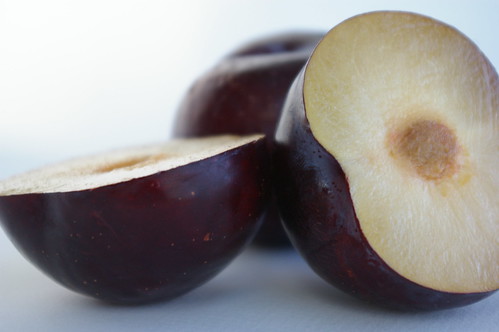
Plums

Plums and spices

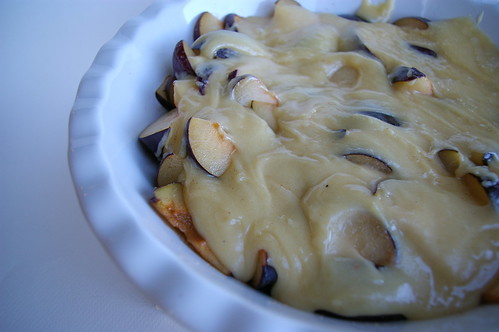
Ready to bake

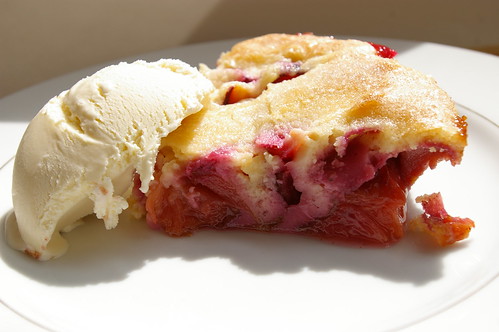
Plum Cake and Ice Cream

This recipe is adapted from Julie (see her post here), which in turn appears to be adapted from elsewhere. That’s one of the things I love about cooking: it’s about taking something and making it your own.

Brown Butter Plum Cake

  • 8 or so plums, thickly sliced (or try peaches, apples, apricots)
  • 3/4 cup + 3 Tbsp. sugar, divided
  • 1/2 tsp. cinnamon
  • dash nutmeg
  • 1/2 cup butter
  • 2 large eggs
  • 1 cup all-purpose flour

Preheat the oven to 350F and butter a pie plate.

Toss the fruit in a bowl with about 2 tbsp. of the sugar, the cinnamon and nutmeg. Spread into the plate.

Melt the butter in a saucepan or small frying pan and keep cooking it for about five minutes until it turns golden. (Swirl the pot occasionally and watch it carefully; it goes quickly from brown to black.)

Pour the butter into a bowl and add the 3/4 cup of sugar, then the eggs and flour. Pour over the fruit and sprinkle with one tablespoon of sugar.

Bake for 40 to 45 minutes until golden and the juices are coming up around the edges.

Delicious with vanilla ice cream.

======================================== 2

Day 224: Big Salad with Grilled Raspberry Chicken and Plum & Browned Butter Pie-Cake


Bookmark this page. Seriously, do it now, before you forget.

I wasn’t sure what to call this. Technically it’s more cake than pie, but calling it cake doesn’t do justice to a pieplateload of juicy fruit topped with a sweet, crunchy topping; it’s not a pie either - it has no pastry but is baked in a pie plate and cut into wedges. The fruit-topping ratio is reminiscent of a crumble or a cobbler, but this is easier than any of the above. I could go as far as to call it foolproof.

Generally I don’t make dessert on a regular Monday night, but I had bought red and yellow plums on the weekend with something specific in mind - cobbler? Pie? Upside down cake? It was something, but today I had no idea what it was, and flipping through the rained-on-and-dried-out magazines on my front step gave no clues. Also, I happened to have whipping cream in the fridge, which almost never happens. So I couldn’t really not make something out of the plums.

I picked up one of my favourite cookbooks, Classic Home Desserts by Richard Sax (a cookbook Mike bought me literally decades ago just because he knew I liked cooking), and flipped through to a recipe I was instantly drawn to years ago, probably because the intro begins with: “Stick a bookmark right here, and leave it in.” It’s called Ligita’s Quick Apple Cake (pg. 383), but it doesn’t need apples. Richard describes it as a “custardy batter quickly poured over apples and baked to a crusty gold.” I wouldn’t describe it as custardy, but would zero in on the browned butter - a simple step that intensifies the nutty buttery flavour a thousandfold. (I cut the butter by a third to 1/2 cup, and will likely try to reduce it a bit more next time, although it undoubtedly contributes to its crunchy, buttery bliss. I would have licked out the butter-melting pot if I wasn’t afraid of burning off my tastebuds.)

That’s it: I’ll call it Browned Butter Bliss. Today, Plum Browned Butter Bliss. This is one of those great go-to recipes that you could use with apples, pears, plums, peaches, berries, apricots, cherries… really anything that needs to be turned into something any time of year. I love the combination of sweet crunch on top and juicy sourness underneath, and the look of both yellow and red plums together.

Oh right, dinner. It seems uneventful after the Bliss - a big salad yukaflux with roasted beets, blueberries, peas from the garden and grilled chicken which I painted with some of the raspberry vinaigrette leftover from last weekend before I grilled it. It sounds much fancier than it actually was.

But seriously - Browned Butter Bliss. Once you make it, it will turn into one of those things that you stir together on autopilot whenever you need something fruity and delicious.

Browned Butter Bliss

(by way of Ligita’s Quick Apple Cake in Classic Home Desserts)

8 or so plums, thickly sliced, or apricots, or 3 peaches, or the original calls for 3 tart apples, peeled and thinly sliced
a squeeze of lemon juice, if you’re using apples
3/4 cup + 3 Tbsp. sugar (or to taste, according to the sweetness of the fruit)
1/2 tsp. cinnamon (or to taste)
1/2 cup butter
2 large eggs
1 cup all-purpose flour

Preheat the oven to 350°F and butter a pie plate.

Toss your fruit in a bowl (or the pie plate) with about 2 Tbsp. sugar and the cinnamon; spread into the plate. Melt the butter in a small saucepan and keep cooking it, swirling the pan occasionally, for about 5 minutes or until it turns golden. Pour into a bowl.

Stir the 3/4 cup of sugar into the butter, then the eggs, then the flour. Pour over the fruit and sprinkle with the last tablespoon of sugar.

Bake for 40-45 minutes, until golden and crusty, and the juices ooze from around the edges. Serve warm with vanilla ice cream, whipped cream or thick vanilla yogurt.

Serves 8.

Plum Tart (rolled dough)

http://www.eatingoutloud.com/2007/03/my-favorite-plum-tart.html

My best Easter memories are from childhood. Waking up early in the morning to see what the Easter Bunny left for me, each year he used a different tactic. Most memorable was the year he used straw to build a nest on the hearth of our fireplace and filled it with an assortment of candy and gifts.

I’ve discovered the Easter Bunny visits less often as you get older. I’m not sure why, but it’s one of the downsides to aging.

I’m not certain what our plans are for the holiday this year, but I plan to make my favorite plum tart. This tart reminds me of Easter since it’s shaped like a little nest and holds the sweet and delectable plums.

The recipe comes from either Gourmet or Bon Apetit, one of those mags. I wrote it down a long time ago but lost track of where I first found it. Rustic and simple, this plum tart’s flakey and tender crust contains a rich and delicious spiced plum mixture.

Rustic Plum Tart

Crust
1 1/4 cups all-purpose flour
2 tablespoons sugar
1/4 teaspoon salt
1/2 cup chilled unsalted butter, cut into 1/2″ pieces
3 tablespoons ice water

Filling
1 1/2 lbs. plums, halved, pitted and cut into slices
6 tablespoons sugar
1/2 teaspoon ground ginger
1/4 teaspoon ground cinnamon
1 tablespoon all-purpose flour
2 tablespoons unsalted butter, melted
1 egg, beaten to blend (for glaze)
1/4 cup apricot preserves

Blend flour, sugar, and salt. Add butter and cut in until mixture resembles coarse meal. Add 2 tablespoons ice water; blend until moist clumps form, adding more water by teaspoons if mixture is still dry. Gather dough into a ball, flatten into a disk. Wrap in plastic and refrigerate for at least 1 hour.

Preheat oven to 400 degrees. Toss plums, 4 tablespoons sugar, ginger, cinnamon in a bowl. Roll dough on floured surface to 12 1/2″ round. Transfer to rimmed baking sheet. Mix 1 tablespoon sugar and 1 tablespoon flour in a small bowl; sprinkle over dough leaving 2″ plain border.

Arrange plums in concentric circles on the dough, leaving 2″ plain border. Drizzle with melted butter. Fold dough border toward center. Brush border with egg glaze; sprinkle with 1 tablespoon sugar. Bake tart until plums are tender and crust is golden, about 35-45 minutes.

Although I haven’t tried it myself, you could likely make this in a tart pan but you may want to blind bake the crust for 15 minutes before filling. When making tarts in pans, I prefer to use one that is nonstick and has a removable bottom.

Stir preserves in saucepan over low heat until melted. Brush over plums. Cool tart 1 hour on baking sheet. Run long knife until tart to loosen. Transfer tart to serving plate and serve at room temperature. Makes 6 servings.

If you like this dessert, you might also like my recipe for baked peaches with amaretti stuffing, figure-friendly rhubarb crisp, or strawberry ice-cream.

Sunday, January 18, 2009

Best Blueberry Pie with Foolproof Pie Dough

Best Blueberry Pie with Foolproof Pie Dough

Cook's Illustrated (July/August 2008)

Doctoredpie

Once a year, when blueberries come in season, we binge.

It always starts the same way, with an innocent trip to the grocery store, and suddenly, out of nowhere, pints of blueberries are buy-one-get-one-free, and we load up.

We eat them by the handfuls in the morning. We make muffins. We serve them with sherbet (which you'll see in an upcoming post). And this year, after reading the most recent Cook's, we were determined to make a pie.

But before we get to the pie, let's talk about the crust made with Cook's Foolproof Pie Dough, and its one surprise ingredient.

Foolproof Pie Dough is a recipe that has appeared in the magazine before, but is well worth being reprinted. The crust is much like other pie crusts, with flour, salt, sugar, butter, shortening and water.

But Cook's has found that by substituting half of the water with vodka, you can avoid a tough pie crust and consistently get a tender, flaky crust.

You can hear Jack Bishop -- of America's Test Kitchen -- talk about the pie crust and explain why vodka works so well on a recent episode of Good Food with Evan Kleiman on KCRW. Never heard of Good Food? Prepare to sacrifice an hour of each week for now on.

(We discovered the show's podcast on iTunes a little over a year ago. It focuses mostly on food trends, farmers markets and restaurants in Southern California, but even if you don't live in SoCal, it's well worth your time. Kleiman -- the chef at LA's Angeli Caffee -- is a treat to listen to and continually brings in a bevy of amazing guests. You can hear the entire segment about the pie dough on KCRW.com/GoodFood. While you're there, do yourself a favor and subscribe to their podcast.)

Cook's Blueberry Pie recipe is focused on creating a pie that sits up when sliced and does not turn into a runny mess, a common problem with blueberry pie since the berries have so much juice. The secret here is the addition of a peeled, grated Granny Smith apple and ground tapioca, which combine to thicken the filling but not interfere with the berries.

So did it work?

A resounding yes! The pie was, of course, delicious and the texture was firm, as advertised. We took issue, though, with the recipe's suggestions for cutting six discs out of the dough (see Cook's photo below) because the holes are so large that our crust had trouble staying together when sliced. But it still tasted amazing.

Honestly, the hardest thing about making this pie was waiting four hours for it to cool, which was torture because the entire house smelled like blueberry pie.

We're already looking forward to next year's blueberries.


Best Blueberry Pie with Foolproof Pie Dough
Cook's Illustrated (July/August 2008)
Subscribe to Cook's Illustrated

Ja08_BlueberryPie_portrait

(THIS PHOTO: Cook's Illustrated)

Foolproof Pie Dough

2 1/2 cups (12 1/2 ounces) unbleached all-purpose flour
1 teaspoon table salt
2 tablespoons sugar
12 tablespoons (1 1/2 sticks) cold unsalted butter, cut into 1/4-inch slices
1/2 cup cold vegetable shortening, cut into 4 pieces
1/4 cup cold vodka
1/4 cup cold water

Blueberry Filling

6 cups fresh blueberries
1 Granny Smith apple, peeled and grated on large holes of box grater
2 teaspoons grated zest and 2 teaspoons juice from 1 lemon
3/4 cup sugar
2 tablespoons instant tapioca, ground
Pinch table salt
2 tablespoons unsalted better, cut into 1/4-inch pieces
1 large egg, lightly beaten with 1 teaspoon water

1. FOR THE PIE DOUGH: Process 1 1/2 cups flour, salt, and sugar in food processor until combined, about 2 one-second pulses. Add butter and shortening and process until homogeneous dough just starts to collect in uneven clumps, about 15 seconds (dough will resemble cottage cheese curds and there should be no uncoated flour). Scrape bowl with rubber spatula and redistribute dough evenly around processor blade. Add remaining cup flour and pulse until mixture is evenly distributed around bowl and mass of dough has been broken up, 4 to 6 quick pulses. Empty mixture into medium bowl.

2. Sprinkle vodka and water over mixture. With rubber spatula, use folding motion to mix, pressing down on dough until dough is slightly tacky and sticks together. Divide dough into two even balls and flatten each into 4-inch disk. Wrap each in plastic wrap and refrigerate at least 45 minutes or up to 2 days.

3. Remove 1 disk of dough from the refrigerator and roll on generously floured (up to 1/4 cup) work surface to 12-inch circle, about 1/8 inch think. Roll dough loosely and rolling pin and unroll into pie plate, leaving at least 1-inch overhang on each side. Working around circumference, ease dough into plate by gently lifting edge of dough with one hand while pressing into plate bottom with other hand. Leave dough that overhangs plate in place; refrigerate while preparing filling until dough is firm, about 30 minutes.

4. FOR THE FILLING: Adjust oven rack to lowest position, place rimmed baking sheet on oven rack and heat oven to 400 degrees. Place 3 cups berries in medium saucepan and set over medium heat. Using potato masher, mash berries several times to release juices. Continue to cook, stirring frequently and mashing occasionally, until about half of berries have broken down and mixture is thickened and reduced to 1 1/2 cups, about 8 minutes. Let cool slightly.

5. Place grated apple in clean kitchen towel and wring dry. Transfer apple to large bowl. Add cooked berries, remaining 3 cups uncooked berries, lemon zest, juice, sugar, tapioca, and salt; toss to combine. Transfer mixture to dough-lined pie plate and scatter butter pieces over filling.

6. Roll out second disk of dough on generously floured (up to 1/4 cup) work surface to 11-inch circle, about 1/8 inch thick. Using 1 1/4 inch round biscuit cutter, cut round from center of dough. Cut around 6 rounds from dough, 1 1/2 inches from edge of center hole and equally spaced around center hole. Roll dough loosely around pin and unroll over pie, leaving at least 1/2 inch overhang on each side.

7. Using kitchen shears, trim bottom layer of overhanging dough, leaving 1/2-inch overhang. Fold dough under itself so that edge of fold is flush with outer rim of pie plate. Flute edges using thumb and forefinger or press with times of fork to seal. Brush top and edges of pie with egg mixture. If dough is very soft, chill in freezer for 10 minutes.

8. Place pie on heating baking sheet and bake 30 minutes. Reduce oven temperature to 350 degrees and continue to bake until juice bubbles and crust is deep golden brown, 30 to 40 minutes longer. Transfer pie to wire rack; cool to room temperature, at least 4 hours. Cut into wedges and serve.

========================

Kenji,

We have some questions about your testing and the resulting pie crust. We would really appreciate your expertise and opinions.

A few of the members consider the dough to be almost too soft and therefore difficult to handle. They have experienced some tearing. We would appreciate your thoughts about this.

I have also seen a good discussion on your testing. There are many questions that may dictate further examination, or you may know the answers.

Mixing - Two Steps: Your recipe calls for processing about 2/3 of the flour to a homogenous dough. The remaining flour is pulsed to distribute.


Question 1. Is it important to full process to a smooth dough in the first step.

Question 2. Have you tested different ratios of four for the two steps.

Question 3. Have you tried leaf lard to replace the shortening? You should!


Adding Alcohol: Your recipe uses half water and half 80 proof vodka. This results in 6.4 ounces of water and 1.6 ounces of ethenol.

Question 4. Did you test changes in the ratio of water to alcohol?

Question 5. Did you test 100 proof vodka?

Question 6. Did you test using other liquors like rum, brandy, or whiskey?

Question 7. Did you test using low proof liqueurs like triple-sec or amaretto?


We are also aware of many old time recipes that included vinegar, supposedly to tenderize the dough. What do you know about this concept?

----------

Wow. Lots of questions. I'm glad everyone is so interested. Here's some answers:

Question 1: It is important to process it at least to the point where there is no dry flour remaining. It may still look a little chunky at this stage, but it won't have the dusty look of dry flour. The idea is that to create flakiness, you need two different elements in the pie crust at the right ratio: flour and water (which forms crisp sheets of gluten) and a flour/fat paste that acts to lubricate and separate the sheets of gluten into separate flakes as it bakes (In the case of a traditional pie crust, the fat/flour paste is also supplemented by little chunks of pure fat - testing showed that only the fat/flour paste was necessary, chunks of fat were redundant). Mixing in only part of the flour with the fat at the beginning before adding the rest of the flour guarantees (within reason) that the ratio of fatty flour to watery flour is the same every time.

Question 2: yes. We tested amounts from 1/3 of a cup blended first, remaining added, all the way up to 1 1/4 cup blended first.

Question 3: yes, but not too seriously. Since good lard is not available to most of our readers, our recipe can't call for it. For the record, CPK renders his own leaf lard in VT and swears by it in his pie crusts.

Question 4: yes. We were using straight up vodka for a while, but we found that there was a limit to how little gluten development you want and how moist the dough can be for easy rolling. We found that half and half gave us a good balance of both.

Question 5: yes. 100 proof vodka can be used. Just use 20% less vodka by volume, and add enough water to make up the difference.

Question 6: yes. We tried calvados, brandy, rum, and bourbon. All of them work to tenderize the crust just like the vodka. As long as the alcohol percentage is the same, you can substitute other liquors for the vodka with good results. Try making an apple pie w/ calvados or brandy, for example.

Question 7: no... but let me know if you do. I don't see any reason why they wouldn't work - just make sure you adjust the ratio of water/liquer in order to get the same final alcohol content as the original recipe or your dough may end up tough. You may also need to reduce the amount of sugar if you're using a very sweet liquer.

As for using vinegar and lemon juice, the idea is that gluten formation is inhibited at lower pH values. But through testing and research, we found that this is not the case. In fact, between a pH of 7 (neutral) and 5 (slightly acidic), gluten formation is actually increased. It's only after you get below a pH of 5 that gluten formation is inhibited. Unfortunately, this would require adding almost 6 tablespoons of lemon juice (or vinegar, both with a pH around 2.3) to the pie crust, making it inedibly sour.


Hope this helps. I'll answer as many questions as I can find time for!

Good luck cooking...
Kenji

Sunday, January 4, 2009

Pain à l'Ancienne

Pain à l'Ancienne, Recipe © Peter Reinhart, Bread Baker’s Apprentice

Days to Make: 2

Day 1: 10 to 15 minutes mixing

Day 2: 2 to 3 hours fermentation, shaping, and panning; 15 to 30 minutes baking

Makes 6 small baguettes, 6 to 8 pizzas, or one 17 by 12-inch focaccia

6 cups (27 ounces) unbleached bread flour

2 1/4 teaspoons (.56 ounce) salt

1 3/4 teaspoons (.19 ounce) instant yeast

2 1/4 cups plus 2 tablespoons to 3 cups (19 to 24 ounces) water ice cold (40°F)

Semolina or cornmeal for dusting

1. Combine the flour, salt, yeast and 19 ounces of water in the bowl of the electric mixer with the paddle attachment and mix for 2 minutes on low speed. Switch to the dough hook and mix for 5 to 6 minutes on medium speed. The dough should be sticky on the bottom of the bowl, but it should release from the sides of the bowl. If not, sprinkle in a small amount of flour until this occurs (or dribble in water if the dough seems too stiff and clears the bottom as well as the sides of the bowl). Lightly oil a large bowl and immediately transfer the dough with a spatula or bowl scraper dipped in water into the bowl. Mist the top of the dough with spray oil and cover the bowl with plastic wrap.

2. Immediately place the bowl in the refrigerator and retard overnight.

3. The next day, check the dough to see if it has risen in the refrigerator. It will probably be partially risen but not doubled in size (the amount of rise will depend on how cold the refrigerator is and how often the door was opened). Leave the bowl of dough out at room temperature for 2 to 3 hours (or longer if necessary) to allow the dough to wake up, lose its chill, and continue fermenting.

4. When the dough has doubled from its original prerefrigerated size, liberally sprinkle the counter with bread flour (about 1/2 cup). Gently transfer the dough to the floured counter with a plastic dough scraper that has been dipped in cold water, dipping your hands as well to keep the dough from sticking to you. Try to degas the dough as little as possible as you transfer it. If the dough is very wet, sprinkle more flour over the top as well as under it. Dry your hands thoroughly and then dip them in flour. Roll the dough gently in the sprinkled flour to coat it thoroughly, simultaneously stretching it into an oblong about 8 inches long and 6 inches wide. If it is too sticky to handle, continue sprinkling flour over it. Dip a metal pastry scraper into cool water to keep it from sticking to the dough, and cut the dough in half widthwise with the pastry scraper by pressing it down through the dough until it severs it, then dipping it again in the water and repeating this action until you have cut down the full length of the dough. (Do not use this blade as a saw; use it as a pincer, pinching the dough cleanly with each cut.) Let the dough relax for 5 minutes.

5. Prepare the oven for hearth baking as shown on pages 91-94, making sure to have an empty steam pan in place. Preheat the oven to 500°F (550°F if your oven goes this high). Cover the back of two 17-by-12-inch sheet pans with baking parchment and dust with semolina flour or cornmeal. Proceed with shaping as shown below.

Shaping Pain À l’Ancienne Baguettes:

Take one of the dough pieces and repeat the cutting action, but this time cut off 3 equal-sized lengths. Then do the same with the remaining half. This should give you 6 lengths.

Flour your hands and carefully lift 1 of the dough strips and transfer it to an inverted parchment-lined pan, gently pulling it to the length of the pan or to the length of your baking stone. If it springs back, let it rest for 5 minutes and then gently pull it out again. Place 3 strips on the pan, and then prepare another pan and repeat with the remaining strips.

6. Score the dough strips as for baguettes (page 90) slashing the tops with 3 diagonal cuts(or see Commentary regarding scissors). Because the dough is sticky, you may have to dip the razor blade, or serrated knife or scissors in water between each cut. You may also omit the cuts if the dough isn't cooperating.

7. Take 1 pan to the preheated oven and carefully slide the dough, parchment and all, onto the baking stone (depending on the direction of the stone, you may choose to slide the dough and parchment off the side of the sheet pan instead of off the end); or bake directly on the sheet pan. Make sure the pieces aren't touching (you can reach in and straighten the parchment or the dough strips if need be). Pour 1 cup of hot water into the steam pan and close the door. After 30 seconds, spray the oven walls with water and close the door. Repeat twice more at 30-second intervals. After the final spray, reduce the oven setting to 475°F and continue baking. Meanwhile, dust the other pan of strips with flour, mist with spray oil, and cover with a towel or plastic wrap. If you don't plan to bake these strips within 1 hour, refrigerate the pan and bake later or the next day. If you’d like to bake them as rustic, ciabatta-style breads, leave them at room temperature for 1 to 2 hours and then bake. As the loaves proof, they will resemble and perform like ciabatta.

8. The bread should begin to turn golden brown within 8 or 9 minutes. If the loaves are baking unevenly at this point, rotate them 180 degrees. Continue baking 10 to 15 minutes more, or until the bread is a rich golden brown and the internal temperature registers at least 205°F.

9. Transfer the hot breads to a cooling rack. They should feel very light, almost airy, and will cool in about 20 minutes. While these are cooling, you can bake the remaining loaves, remembering to remove the parchment from the oven and turn the oven up to 500°F or higher before baking the second round.

COMMENTARY:

This dough also makes a great oil-free pizza dough or focaccia. Refer to the variations that follow and then the formulas for Pizza Napoletana (page 207) and Focaccia (page 159).

This dough is very sticky, like ciabatta dough, so it is best made in an electric mixer or a food processor (page 55). However, if mixing by hand, use the method described on page 56.

One of the testers of this recipe, Jill Myers, suggested using sharp scissors to score the bread instead of a knife or razor. This is a great idea, as the wet dough is difficult to slit in the normal manner. If you are using this method, try to get a long angle with the shears and make a long cut rather than just short snips.


Pain À l’Ancienne Pizza: Heavily flour the counter and gently transfer the fully fermented dough from the bowl to the counter with a plastic scraper that has been dipped in cold water, dipping your hands as well to keep the dough from sticking to you. Divide the dough by continually dipping the pastry scraper into water and cutting the dough into 6 to 8 equal pieces. Gently round the pieces into balls, being careful not to punch down and expel any more gas than necessary. Line a sheet pan with baking parchment and spray lightly with oil. Place the floured dough balls on the parchment. Mist them with spray oil and place the pan into a food-grade plastic bag or loosely cover with plastic wrap, and return the pan to the refrigerator, unless you plan to make the pizzas immediately. These pizza doughs will keep for up to 3 days in the refrigerator. (You may also put them into the freezer in individual zipper bags, and keep them for up to three months.) Remove the desired number of dough balls from the refrigerator 2 hours before shaping and baking your pizza as you always do.

Pain À l’Ancienne Foccacia: Line a 17 by-12-inch sheet pan with baking parchment. With floured hands, take the fully fermented dough from the bowl and proceed with shaping instructions on page 162. Ferment at room temperature for about 2 to 3 hours, or until the dough rises and fills the pan, rising to about 1 inch thick. Proceed with the baking instructions for focaccia.

Saturday, January 3, 2009

Five Minutes a Day for Fresh-Baked Bread

Five Minutes a Day for Fresh-Baked Bread

By Jeff Hertzberg and Zoë François

The Secret: Keep Dough Refrigerated

It is easy to have fresh bread whenever you want it with only five minutes a day of active effort. Just mix the dough and let it sit for two hours. No kneading needed! Then shape and bake a loaf, and refrigerate the rest to use over the next couple weeks. Yes, weeks! The Master Recipe (below) makes enough dough for many loaves. When you want fresh-baked crusty bread, take some dough, shape it into a loaf, let it rise for about 20 minutes, then bake. Your house will smell like a bakery, and your family and friends will love you for it.

I was trained as a scientist, not as a chef. That helped in developing a new process for homemade bread, but I never could have brought the recipes to this level without the rigorous standards of a professional — my co-author Zoë is a Culinary Institute of America-trained pastry chef. Over several years, we found how to subtract the various steps that make the classic technique so time-consuming, and identified a few that couldn’t be omitted. Then Zoë worked some pastry chef magic. She figured out that we could use stored dough for desserts, too. It all came down to one fortuitous discovery: Pre-mixed, pre-risen, high-moisture dough keeps well in the refrigerator.

How it All Began

Like most kids, my brother and I loved sweets, so dessert was our favorite time of day. We’d sit in the kitchen, devouring frosted supermarket doughnuts. “Those are too sweet,” my grandmother would say. “Me, I’d rather have a piece of good rye bread, with cheese on it. It’s better than cake.”

Secretly, I knew she was right. I could finish half a loaf of very fresh, very crisp rye bread by myself, with or without butter. The right stuff came from a little bakery in Queens. The crust was crisp, thin and caramelized brown. The crumb was moist and dense, chewy but never gummy, and bursting with tangy yeast, rye and wheat flavors. It made great toast, too — and yes, it was better than cake.

When I was a kid, handmade bread was available all over New York City, and it wasn’t a rarefied delicacy. Everyone took it for granted. It was not a stylish addition to affluent lifestyles; it was a simple comfort food brought here by modest immigrants. But now the ubiquitous corner shops turning out great European breads are no longer so ubiquitous. And nobody’s grandmother would ever have paid $6 for a loaf of bread.

So Zoë and I decided to do something about it. Our book, Artisan Bread in Five Minutes a Day, is our attempt to help people re-create the great ethnic breads of years past, in their own homes, without investing serious time or effort. Using our straightforward, fast and easy recipes, anyone can create artisan bread and pastries at home with minimal equipment.

Traditional breads need lots of attention, especially if you want to use a “starter” for that natural, tangy taste. Starters need to be cared for. Dough needs to be kneaded until resilient, set to rise, punched down, allowed to rise. Few busy people can go through this every day, if ever.

What about bread machines? The machines solve the time problem and turn out uniformly decent loaves, but unfortunately, the crust is soft and dull-flavored, and without tangy flavor in the crumb (unless you use and maintain a time-consuming sourdough starter).

By pre-mixing high-moisture dough (without kneading) and then storing it, daily bread baking becomes easy; the only steps you do every day are shaping and baking. As the dough ages, it takes on sourdough notes reminiscent of great starters. Because this dough is wetter than most, it can be stored in the refrigerator for up to two weeks. And kneading this kind of dough would add little to the overall product; it can actually limit the volume and rise that you’ll get. That, in a nutshell, is how you make artisan breads with the investment of only five minutes a day of active effort.

A one- or two-week supply of dough is made in advance and refrigerated. Mixing it takes less than 15 minutes. Every day, cut off a hunk of dough and quickly shape it without kneading. Allow it to rest briefly on the counter and then toss it in the oven. We don’t count the rest time or baking time (usually about 30 minutes to an hour each) in our calculation, because you can do something else while that’s happening. If you bake after dinner, the bread will still be fresh the next day (higher moisture breads stay fresh longer), but the method is so convenient that you’ll probably find you can cut off some dough and bake a loaf every morning before your day starts. If you want to have one thing you do every day that is simply perfect, this is it!

Ingredients and Equipment

Great breads really only require four basic ingredients: flour, water, yeast and salt. The rest is detail. Here’s a short guide to the basic ingredients and equipment you’ll need to make artisan loaves.

Unbleached, white, all-purpose flour: Has adequate protein (around 10 percent) to create a satisfying “chew,” but low enough to prevent heaviness. We prefer unbleached flours because bleaching removes some protein, not to mention adding unnecessary chemicals.

Whole wheat flour: Contains the germ and bran, both of which are healthful and tasty. Together they add a slightly bitter, nutty flavor that many people enjoy.

Bread flour: For chewier bread, substitute bread flour (about 12 percent protein) for all-purpose white flour by decreasing the amount slightly (by about a quarter cup for every 6 cups of all-purpose).

Yeast: Use what’s readily available and buy in bulk rather than packets, which are much more expensive.

Salt: Use noniodized coarse kosher or sea salt.

Baking stone: Use a high-­quality, ­half-­inch-­thick stone. The porous stone absorbs moisture from your dough, allowing a thin, crackling, crisp crust to form — one of the keys to artisanal baking.

Pizza peel: This long-handled board helps slide doughs onto a hot stone. A cookie sheet or cutting board will work, but will be more difficult to handle.

Broiler tray: A pan to hold water for steam during baking.

The Master Recipe

The artisan free-form loaf called the French boule is the basic model for all the no-knead recipes. The round shape (boule in French means “ball”) is the easiest to master. You’ll learn how wet the dough needs to be (wet, but not so wet that the finished loaf won’t retain its form) and how to shape a loaf without kneading. And you’ll discover a truly revolutionary approach to baking: Take some dough from the fridge, shape it, leave it to rest, then let it bake while you’re preparing the rest of the meal.

Keep your dough wet — wetter doughs favor the development of sourdough character during storage. You should become familiar with the following recipe before going through any of the others.

Mixing and Storing the Dough

1. Heat the water to just a little warmer than body temperature (about 100 degrees Fahrenheit).

2. Add yeast and salt to the water in a 5-quart bowl or, preferably, in a resealable, lidded container (not airtight — use container with gasket or lift a corner). Don’t worry about getting it all to dissolve.

3. Mix in the flour by gently scooping it up, then leveling the top of the measuring cup with a knife; don’t pat down. Mix with a wooden spoon, a high-capacity food processor with dough attachment, or a heavy-duty stand mixer with dough hook, until uniformly moist. If hand-mixing becomes too difficult, use very wet hands to press it together. Don’t knead! This step is done in a matter of minutes, and yields a wet dough loose enough to conform to the container.

4. Cover loosely. Do not use screw-topped jars, which could explode from trapped gases. Allow the mixture to rise at room temperature until it begins to collapse (or at least flatten on top), approximately two hours, depending on temperature. Longer rising times, up to about five hours, will not harm the result. You can use a portion of the dough any time after this period. Refrigerated wet dough is less sticky and easier to work with than room-temperature dough. We recommend refrigerating the dough at least three hours before shaping a loaf. And relax! You don’t need to monitor doubling or tripling of volume as in traditional recipes.

On Baking Day

5. Prepare a pizza peel by sprinkling it liberally with cornmeal to prevent the loaf from sticking to it when you slide it into the oven.

Sprinkle the surface of the dough with flour, then cut off a 1-pound (grapefruit-sized) piece with a serrated knife. Hold the mass of dough in your hands and add a little more flour as needed so it won’t stick to your hands. Gently stretch the surface of the dough around to the bottom on four “sides,” rotating the ball a quarter-turn as you go, until the bottom is a collection of four bunched ends. Most of the dusting flour will fall off; it doesn’t need to be incorporated. The bottom of the loaf will flatten out during resting and baking.

6. Place the ball on the pizza peel. Let it rest uncovered for about 40 minutes. Depending on the dough’s age, you may see little rise during this period; more rising will occur during baking.

7. Twenty minutes before baking, preheat oven to 450 degrees with a baking stone on the middle rack. Place an empty broiler tray for holding water on another shelf.

8. Dust the top of the loaf liberally with flour, which will allow the slashing, serrated knife to pass without sticking. Slash a 1⁄4-inch-deep cross, scallop or tick-tack-toe pattern into the top. (This helps the bread expand during baking.)

9. With a forward jerking motion of the wrist, slide the loaf off the pizza peel and onto the baking stone. Quickly but carefully pour about a cup of hot water into the broiler tray and close the oven door to trap the steam. Bake for about 30 minutes, or until the crust is browned and firm to the touch. With wet dough, there’s little risk of drying out the interior, despite the dark crust. When you remove the loaf from the oven, it will audibly crackle, or “sing,” when initially exposed to room temperature air. Allow to cool completely, preferably on a wire rack, for best flavor, texture and slicing. The perfect crust may initially soften, but will firm up again when cooled.

10. Refrigerate the remaining dough in your lidded (not airtight) container and use it over the next two weeks: You’ll find that even one day’s storage improves the flavor and texture of your bread. This maturation continues over the two-week period. Cut off and shape loaves as you need them. The dough can also be frozen in 1-pound portions in an airtight container and defrosted overnight in the refrigerator prior to baking day.


The Master Recipe: Boule

(Artisan Free-Form Loaf)

Makes 4 1-pound loaves

3 cups lukewarm water
1 1⁄2 tbsp granulated yeast (1 1⁄2 packets)
1 1⁄2 tbsp coarse kosher or sea salt
6 1⁄2 cups unsifted, unbleached, all-purpose white flour
Cornmeal for pizza peel


Tips to Amaze Your Friends

The “6-3-3-13” rule. To store enough for eight loaves, remember 6-3-3-13. It’s 6 cups water, 3 tablespoons salt, 3 tablespoons yeast, and then add 13 cups of flour. It’ll amaze your friends when you do this in their homes without a ­recipe!

Lazy sourdough shortcut. When your dough container is empty, don’t wash it! Just scrape it down and incorporate it into the next batch. In addition to saving cleanup, the aged dough stuck to the sides will give your new batch a head start on sourdough flavor.

Variation: Herb Bread. Add a couple teaspoons of your favorite dried herbs (double if fresh) to the water mixture.


Neapolitan Pizza Dough

The secrets to this pizza are to keep the crust thin, don’t overload it, and to bake it quickly at a high temperature so it ­doesn’t cook down to a soup. It’s unlike anything most of us are used to eating — especially if you make fresh mozzarella!

1 pound ­pre-­mixed boule dough
Cornmeal for covering the pizza peel
Topping: your favorite seasonal ingredients

  1. 20 minutes before baking, preheat the oven with a baking stone (scraped clean) at your oven’s maximum temperature — the hotter, the better. (Another option is to use the baking stone over a grill, which takes about two-thirds of the time.)
  2. Prepare the toppings in advance. The key to a pizza that slides right off the peel is to work ­quickly.
  3. Follow Step 5 of The Master Recipe (above).
  4. Flatten the dough into a 1/8-inch-thick round with your hands and a rolling pin on a wooden board. Dust with flour to keep the dough from sticking. (A little sticking can help overcome the dough’s re­sis­tance to stretching, though, so don’t overuse flour.) You also can let the partially rolled dough relax for a few minutes to allow further rolling. Stretching by hand may help, followed by additional rolling. Place the rolled-­out dough onto a liberally ­cornmeal-­covered pizza peel.
  5. Distribute your toppings over the surface, leaving some of its surface exposed so you can appreciate the individual ingredients — and the magnificent crust! — of the final product. No further resting is needed.
  6. Turn on the exhaust fan (or use lower heat and bake a few minutes longer), because some of the cornmeal will smoke. Slide the pizza onto the stone (­back-­and-­forth shakes can help dislodge it). Check for doneness in 8 to 10 minutes. Turn the pizza around if one side is browning too fast. It may need up to 5 more minutes.
  7. Allow to cool slightly on a rack before serving.

Makes 1 ­12- to 14-inch pizza to serve 2 to 4.


100 Percent Whole-Wheat Sandwich Bread

Whole wheat flour has a nutty, slightly bitter flavor, and it caramelizes easily, yielding a rich, brown loaf. Milk and honey are tenderizers, and their sweetness complements the bitter notes. Although we’ve showcased a loaf-pan method here, this dough also makes lovely free-form loaves on a baking stone.

1 1⁄2 tbsp granulated yeast (1 1⁄2 packets)
1 tbsp plus 1 tsp salt
1/2 cup honey
5 tbsp neutral-flavored oil, plus more for greasing the pan
1 1⁄2 cups lukewarm milk
1 1⁄2 cups lukewarm water
6 2⁄3 cups whole wheat flour

  1. Mix the yeast, salt, honey, oil, milk and water in a 5-quart bowl or other container.
  2. Mix in the flour using a spoon, high-capacity food processor with dough attachment, or a heavy-duty stand mixer with dough hook.
  3. Cover loosely, and allow to rest at room temperature until the dough rises and collapses (or flattens on top); about 2 to 3 hours.
  4. The dough can be used immediately after the initial rise, though it is easier to handle when cold. Refrigerate in a lidded (not airtight) container and use over the next several days.
  5. On baking day, lightly grease a 9-by-4-by-3-inch loaf pan. Using wet hands, scoop out a 11⁄2 pound (cantaloupe-sized) hunk of dough. Keeping your hands wet (it’ll be sticky!), quickly shape it into a ball following the method in Step 5 of The Master Recipe (above).
  6. Drop the loaf into the prepared pan. You’ll want enough dough to fill the pan slightly more than half-full.
  7. Allow the dough to rest for 1 hour and 40 minutes. Flour the top of the loaf and slash, using the tip of a serrated bread knife.
  8. 5 minutes before baking time, preheat the oven to 350 degrees, with an empty broiler tray on another shelf.
  9. Place the loaf in the center of the oven. Pour 1 cup of hot water into the broiler tray and quickly close the door. Bake for 50 to 60 minutes, or until deeply browned and firm.
  10. Allow to cool completely before slicing in order to cut reasonable sandwich slices.

Makes 3 1 1⁄2 pound loaves.


Sticky Pecan Caramel Rolls

This crowd-pleaser was our first attempt to make dessert from stored bread dough. It was so successful that it reshaped our view of what this technique could accomplish. The flavors were enhanced by using stored dough, and the butter and sugar seeped into the folds, approximating enriched sweet doughs.

1 1⁄2 pounds pre-mixed boule dough

TOPPING
6 tbsp unsalted butter, softened
1/2 tsp salt
1/2 cup brown sugar
30 pecan halves

FILLING
4 tbsp salted butter, softened
1/4 cup sugar
1 tsp ground cinnamon
1/4 tsp freshly grated nutmeg
Pinch of ground black pepper
1/2 cup toasted pecans, chopped

  1. Cream together the butter, salt and brown sugar. Spread evenly in a 9-inch cake pan. Scatter the pecan halves over the mixture and set aside.
  2. Dust the refrigerated dough with flour and cut off a cantaloupe-sized piece. Dust the piece with flour and shape it into a ball following the method in Step 5 of The Master Recipe (above).
  3. With a rolling pin, roll out the dough to a 1/8-inch thick rectangle. Add only enough flour to prevent it from sticking.
  4. Cream together the butter, sugar and spices for the filling. Spread evenly over the dough and sprinkle with chopped nuts. Roll the dough into a log. If it’s too soft to cut, chill for 20 minutes.
  5. With a serrated knife, cut the log into 8 pieces and arrange over the pecans, with the “swirled” edge facing up. Cover loosely with plastic wrap and allow to rest and rise 1 hour (or 40 minutes if you’re using fresh, unrefrigerated dough).
  6. 5 minutes before baking time, preheat the oven to 350 degrees.
  7. Bake about 40 minutes, or until golden brown and set in center. While still hot, run a knife around the pan to release the rolls, and invert immediately onto a serving dish.

Makes 6 to 8 large rolls.


Naan

“Naan has become my family’s favorite bread to make while camping in the woods. All we need is a 12-inch cast-iron skillet on our sturdy Coleman stove to have freshly baked bread. We always attract a crowd of curious campers drawn to the aroma wafting amidst the wood smoke.” — Jeff

This delicious and buttery Indian flatbread is traditionally made in a huge cylindrical clay tandoori oven, with the wet dough slapped directly onto the oven’s hot walls. Our naan is done in a hot, cast-iron skillet, or a heavyweight nonstick skillet. Butter or oil will work in lieu of Indian clarified butter (ghee), but the taste won’t be as authentic. You can find ghee at South Asian or Middle Eastern markets.

This recipe also has the distinction of producing our fastest bread, since it’s done on the stovetop without an oven preheat, and there’s no need to rest the dough. You can easily make one of these just before dinner, even on busy nights (so long as you have the dough in the fridge). Makes 1 naan.

1/4 pound (peach­sized portion) of pre-mixed boule dough
1 tablespoon ghee (commercial or homemade), or neutral-flavored oil or butter

  1. Dust the surface of the refrigerated dough with flour and cut off a 1/4-pound piece. Dust the piece with more flour and quickly shape it into a ball by stretching the surface of the dough around to the bottom on all four sides, rotating the ball a quarter-turn as you go. Using your hands and a rolling pin, and minimal flour, roll out to a uniform thickness of 1/8-inch and a diameter of 8 to 9 inches.
  2. Heat a heavy 12-inch cast­iron skillet over high heat on the stovetop. When water droplets flicked into the pan skitter across the surface and evaporate quickly the pan is ready. Add the ghee or oil.
  3. Drop the rolled dough into the skillet, decrease the heat to medium, and cover the skillet to trap the steam and heat.
  4. Check for doneness with a spatula at about 3 minutes, or sooner if you smell overly quick browning. Adjust the heat as needed. Flip the naan when the underside is richly browned.
  5. Continue cooking another 2 to 6 minutes, or until the naan feels firm, even at the edges, and the second side is browned. If you’ve rolled a thicker naan, or if you’re using dough with whole grains, you’ll need more pan time.
  6. Remove the naan from the pan, brush with butter, and serve.

Caramelized Onion and Herb Dinner Rolls

“A friend once told me she times her cooking so that the onions are caramelizing as her guests arrive, claiming there is nothing more aromatic and inviting. I ­can’t help but agree with her.” — Zoë

Caramelizing the onions is easy and rewarding and can be used to dress up any of our savory doughs. Another favorite is to use the onion mixture with Manchego cheese as a pizza topping (see the Neapolitan pizza dough recipe above). Because it takes some time to achieve perfectly caramelized onions you may want to double the recipe to have some on hand; they freeze for months. Makes 6 rolls.

1 pound (grapefruit-sized portion) of pre-mixed boule dough
3 tablespoons olive oil
2 large onions, chopped
1 teaspoon salt
1 tablespoon vermouth or white wine
1 teaspoon white wine vinegar
2 tablespoons brown sugar
1 teaspoon dried thyme or oregano (or 2 teaspoons chopped fresh thyme and oregano leaves)
4 tablespoons water
Freshly ground black pepper, to taste
Cornmeal for pizza peel

  1. Heat the olive oil in a large skillet on ­medium-­low heat. Add the onions, salt, vermouth, vinegar, brown sugar, herbs, and water to the oil and cook for about 25 minutes, stirring occasionally, until the onions are nicely caramelized. Add more water when needed to prevent burning.
  2. Dust the surface of the refrigerated dough with flour and cut off a 1-­pound (grapefruit-­size) piece. Dust the piece with more flour and quickly shape it into a ball by stretching the surface of the dough around to the bottom on all four sides, rotating the ball a ­quarter-­turn as you go.
  3. To form the dinner rolls, divide the ball into 6 roughly equal portions (each about the size of a plum). Shape each one into a smooth ball. Allow them to rest and rise on a ­cornmeal-­covered pizza peel for 40 minutes (or just 20 minutes if you’re using fresh, unrefrigerated dough).
  4. Twenty minutes before baking time, preheat the oven to 450 degrees, with a baking stone placed on the middle rack. Place an empty broiler tray on any other shelf that won’t interfere with the rising bread.
  5. Just before baking, sprinkle the rolls liberally with flour and cut a 1⁄2-inch cross pattern into the top, using a serrated bread knife or sharp kitchen scissors. Fill the resulting space with about 1 tablespoon of the onion mixture.
  6. Slide the rolls directly onto the hot stone. Pour 1 cup of hot tap water into the broiler tray, and quickly close the oven door. Bake for 20 to 25 minutes, or until deeply browned and firm.
  7. Allow to cool before eating.

HIGHLY RECOMMENDED by the Mother Earth News editors:

Artisan Bread in Five Minutes a Day by Jeff Hertzberg and Zoë François (Thomas Dunne Books, an imprint of St. Martin’s Press, LLC, Copyright 2007). The Mother Earth News editors whole-heartedly offer a big fat stamp of approval to this incredible cookbook, which proves hands-down that there is enough time in life for baking, and that baking at home can save you hundreds every year. The recipes reprinted here give you just a taste of the numerous treats you’ll be able to create — deftly! — by mastering one simple technique. Check it out for all kinds of troubleshooting tips and many more mouthwatering recipes (Almond Cream Pastry, Chocolate-Raisin Babka or Homemade Beignets, anyone?).